
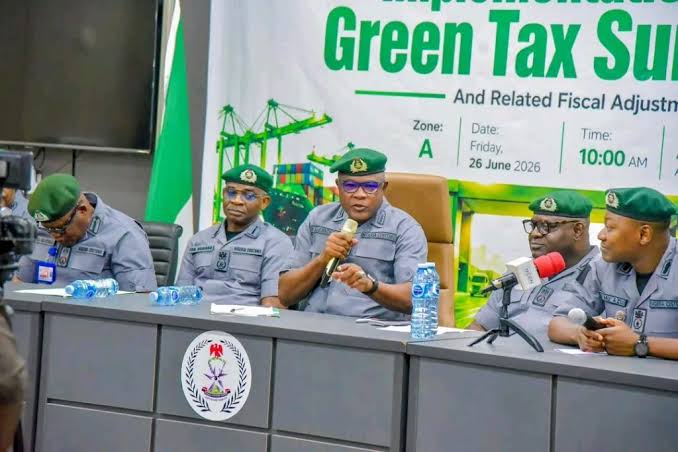
Understanding Nigeria’s New Green Tax Surcharge:
What Every Vehicle Importer Should Know
Effective 1 July 2026, the Federal Government introduced the Green Tax Surcharge as part of the 2026 Fiscal Policy Measures.
For many importers, the first question is simple: “Will importing my vehicle now cost more?”
The answer is: Not necessarily.
The policy introduces a new environmental surcharge while simultaneously reducing import duty on vehicles.
Understanding how these two changes work together is critical before making purchasing decisions.
What exactly is the Green Tax?
Think of it as an environmental surcharge, not a replacement for customs duty.
Instead of taxing every imported vehicle equally, government now considers engine size because larger engines generally consume more fuel and emit more carbon.
The Green Tax therefore encourages importation of cleaner and more fuel-efficient vehicles.
Which vehicles are affected?
No Green Tax
Passenger vehicles below 2,000cc
Examples include many:
- Toyota Corolla
- Toyota Yaris
- Honda Civic
- Kia Rio
- Hyundai Accent
- Nissan Sunny
These vehicles continue to pay normal customs charges without Green Tax.
2% Green Tax
Vehicles between 2,000cc and 3,999cc
Examples include:
- Toyota Camry 2.5L
- Toyota Highlander
- Lexus RX350
- Honda Pilot
- Ford Edge
Talk to us on your next shipping project to Nigeria-
4% Green Tax
Vehicles 4,000cc and above
Examples include:
- Lexus LX570
- Toyota Land Cruiser V8
- Mercedes G-Class (certain variants)
- Range Rover V8
- Nissan Patrol V8
These are considered higher-emission vehicles and attract the highest surcharge.
Good News: Government also reduced Import Duty
Many people have focused only on the Green Tax.
But another important part of the policy is the reduction in vehicle import duty.
New Vehicles
Previous Import Duty: 20%
New Import Duty: 10%
Reduction: 50%
Talk to us on your next shipping project to Nigeria-
Used Vehicles
Previous Import Duty: 15%
New Import Duty: 5%
Reduction: Two-thirds lower than before.
READ: Ro-ro Freight Shipping to Nigeria | Guide to Shipping Vehicles, Heavy Equipment & Customs Clearance
Does this mean importation becomes cheaper?
Not automatically.
Import cost now depends on:
✔ Engine capacity
✔ Whether the vehicle is new or used
✔ Customs value
✔ Other applicable port charges
For many smaller-engine vehicles, the lower import duty may offset the absence of Green Tax, potentially reducing overall customs charges.
For larger-engine luxury vehicles, the Green Tax may offset part of the import duty reduction.
Each shipment should therefore be evaluated individually before importation.
Electric Vehicles become more attractive
One of the biggest winners under this policy is the Electric Vehicle (EV) market.
Electric vehicles are exempt from the Green Tax.
This supports government’s long-term transition towards cleaner transportation.
Businesses considering fleet replacement may now have stronger financial reasons to evaluate EV options.
Public Transportation also benefits
Mass transit buses are exempted.
This is consistent with government’s objective of encouraging public transportation while reducing emissions.
What Importers should do before shipping
This policy makes pre-import planning more important than ever.
Before purchasing a vehicle, importers should confirm:
- Exact engine capacity
- Correct HS Code classification
- Customs valuation implications
- Total landed cost
- Green Tax applicability
- Available exemptions
A small difference in engine capacity could significantly affect total import cost.
READ: Ro-ro Freight Shipping to Nigeria | Guide to Shipping Vehicles, Heavy Equipment & Customs Clearance
What this means for Customs Clearance
Licensed Customs Agents will now be required to correctly declare:
- Engine capacity
- Appropriate HS Code
- Green Tax category
- Applicable exemptions
Incorrect declarations may result in delays, reassessment or compliance issues during clearance.
Valuehandlers Insight
The Green Tax should not simply be viewed as “another government tax.”
It represents a shift in Nigeria’s vehicle import policy—from a system based primarily on revenue generation to one that also incorporates environmental considerations.
For importers, success will increasingly depend on accurate shipment planning, proper tariff classification, and understanding the total landed cost before cargo leaves the supplier’s warehouse.
Businesses that obtain professional customs advisory before shipment are likely to make better purchasing decisions and avoid unexpected costs at the port.
Key Takeaways
- Vehicles below 2,000cc are exempt from Green Tax.
- Vehicles 2,000–3,999cc attract a 2% Green Tax surcharge.
- Vehicles 4,000cc and above attract a 4% Green Tax surcharge.
- Electric vehicles, mass transit buses, locally manufactured vehicles, specified parts, and passenger vehicles below 2,000cc are exempt.
- Import duty has been reduced to 10% for new vehicles and 5% for used vehicles.
- The Green Tax is assessed separately from normal customs duty.
- Importers should calculate total landed cost before purchasing rather than relying solely on the published tax rates.
Valuehandlers’ Professional Perspective
The introduction of the Green Tax signals a broader policy shift rather than an isolated tax change. Beyond revenue collection, it reflects Nigeria’s effort to encourage cleaner vehicle imports while aligning with regional tariff frameworks and environmental objectives. For importers, the most important takeaway is that accurate pre-shipment cost analysis has become even more valuable. Understanding how engine capacity, customs valuation, tariff classification, and applicable exemptions interact will help businesses make informed purchasing decisions, avoid unexpected clearance costs, and maintain compliance throughout the import process.
